
UK Aluminium Alliance
About the UK Aluminium Alliance
The UK Aluminium Alliance brings industry and government together to secure a resilient, competitive and low-carbon aluminium supply chain for the UK – building the evidence, alliances and pathways for growth, innovation and decarbonisation.
The UK Aluminium Alliance (UKAA) is an industry-steered initiative convened by the Aluminium Federation (ALFED), in partnership with Dr Mark Jones of CONETZ (Connecting for Net Zero) to strengthen the role of aluminium in the UK economy. It brings together producers, processors, recyclers, OEMs, and government partners with a single mission: Build the evidence, alliances and mechanisms to secure a resilient, low carbon aluminium supply in the UK to support and grow net zero manufacturing.
The Alliance provides a neutral, evidence-based platform where industry priorities can be aggregated, demand signals clarified, and clear policy pathways agreed. It does not steer commercial investment or coordinate markets; instead, it equips members with the data, tools, and influence they need to thrive.
Why an Aluminium Alliance
The aluminium sector faces a convergence of pressures:
- Higher industrial energy costs than international peers.
- Fragmented data on capacity, material flows, and regional strengths.
- Skills succession gaps across technical and operational roles.
- A perception that aluminium is not yet “strategic” for UK policy or procurement.
At the same time, government is driving for sovereign, net-zero supply chains and more circular use of critical materials. The Alliance is the vehicle to organise around these challenges, reduce fragmentation, and amplify the sector’s voice in shaping solutions.
To be eligible for ALFED membership, companies must meet the following conditions:
- Assemble facts about demand, capability, and flows.
- Surface investable opportunities in decarbonisation, circularity, and new markets.
- Speak with one voice on energy, skills, standards, and procurement, while remaining compliant and commercially neutral.
- Resilience – able to withstand energy and trade shocks through secure scrap/primary flows, flexible domestic capacity, diversified markets, and robust skills and cyber-physical safeguards.
- Competitive – able to invest and grow on a level playing field with international peers.
- Low-carbon – reducing emissions through electrification, efficiency, circularity, and verified standards.
- Visible – with clear maps of capability, demand, and skills to attract buyers, funders, and government support.
- Influential – offering clear, evidence-based recommendations that shape policy and procurement.
Why the UK Needs an Aluminium Alliance
Aluminium underpins critical industries, from defence and aerospace to construction, packaging, and mobility. Without action, the UK risks losing competitiveness, underutilising domestic capacity, and missing opportunities to decarbonise.
The UKAA provides the structure to:
The Vision and Purpose
The Alliance’s vision is to create a sector that is:
The purpose is not to replace individual strategies, but to provide shared evidence and collective leverage so every ALFED member can strengthen their business case and access opportunities.
Shaped by Industry - Kickstarting the Conversation

The journey began with the first workshop in April 2025, where members highlighted the need for a coordinated platform to tackle cross-cutting challenges in energy, data, skills, perception, scrap utilisation, processing capability, industrial demand, and policy.
From that workshop, the UKAA framework was drafted, defining eight themed “asks” across Industry, Policy, and ALFED roles. This ensured the Alliance was shaped by members, for members, grounded in practical outcomes and safeguarded by strict compliance rules.
The 8 Key ‘Asks’ of the Alliance
The UKAA framework is built on eight core themes, each with clear roles for Industry, Policy, and ALFED & Members:
1. Energy
- Industry: Develop site-level decarbonisation and electrification pathways, including heat recovery and efficiency upgrades.
- Policy: Create a competitive energy framework aligned with peer countries and bring forward an SME-inclusive British Industrial Competitiveness Scheme.
- ALFED: Deliver an anonymised energy-intensity benchmark and lobby for reforms, giving members credible ROI actions and evidence for investment cases.
2. Data
- Industry: Contribute structured, non-sensitive operational data.
- Policy: Support a DBT-validated sector dashboard and safe data-sharing rules.
- ALFED: Build and maintain a national map and commodity-code explorer, enabling members to identify gaps and opportunities.
3. Skills and Futureproofing
- Industry: Identify priority roles, retention pinch-points, and mentoring capacity, supporting pilots via Aluminium Allies.
- Policy: Enable flexible SME use of the Apprenticeship Levy and recognise aluminium in green-skills funding.
- ALFED: Coordinate a UK Aluminium Skills Pathway, delivering shared resources and recruitment/retention support.
4. Perception and Narrative
- Industry: Share modern case studies and host site visits.
- Policy: Recognise aluminium’s role in industrial strategy, procurement, and net zero.
- ALFED: Run a coordinated storytelling plan, improving visibility and buyer confidence.
5. Material Supply (Initial HS 7602 focus)
- Industry: Improve grade-level scrap visibility and explore closed-loop pathways.
- Policy: Drive advanced standards/specs enabling higher-value use of post-consumer aluminium.
- Convene a Scrap Working Group and publish guidance; members gain access to higher-value markets and reduced risk.
6. Processing Capability
- Industry: Identify bottlenecks and opportunities in casting, rolling, extrusion and finishing.
- Policy: Streamline planning and permitting for brownfield expansion and energy/carbon upgrades.
- ALFED: Collate capability maps and broker buyer standards dialogues.
7. Industrial Product Drive
- Industry: Work with buyers to specify low-carbon and circular aluminium in products.
- Policy: Embed domestic content, circularity, and verified carbon intensity in procurement.
- ALFED: Facilitate OEM–recycler pilots and publish “How to Buy Low Carbon Aluminium” notes.
8. Policy
- Industry: Provide evidence-based submissions on barriers to growth and decarbonisation.
- Policy: Establish structured engagement across DBT, DESNZ, MoD, and devolved governments.
- ALFED: Translate Alliance outputs into policy-ready recommendations, giving members an earlier voice in reforms.
- Energy pricing and infrastructure are the single biggest blockers to decarbonisation and competitiveness.
- There is strong appetite to share non-sensitive operational data if it helps build a validated national picture of capability and demand.
- Skills gaps, especially in technical and mid-career roles, need new pathways, mentoring, and better use of the apprenticeship levy.
- Outdated perceptions of aluminium must be challenged through modern case studies and site visits.
- Greater visibility of HS 7602 scrap grades and specifications is critical to unlocking higher-value, closed-loop markets.
This feedback shaped the Alliance framework and confirmed members want practical outputs: dashboards, benchmarks, pilots, and policy packs, that deliver value quickly.
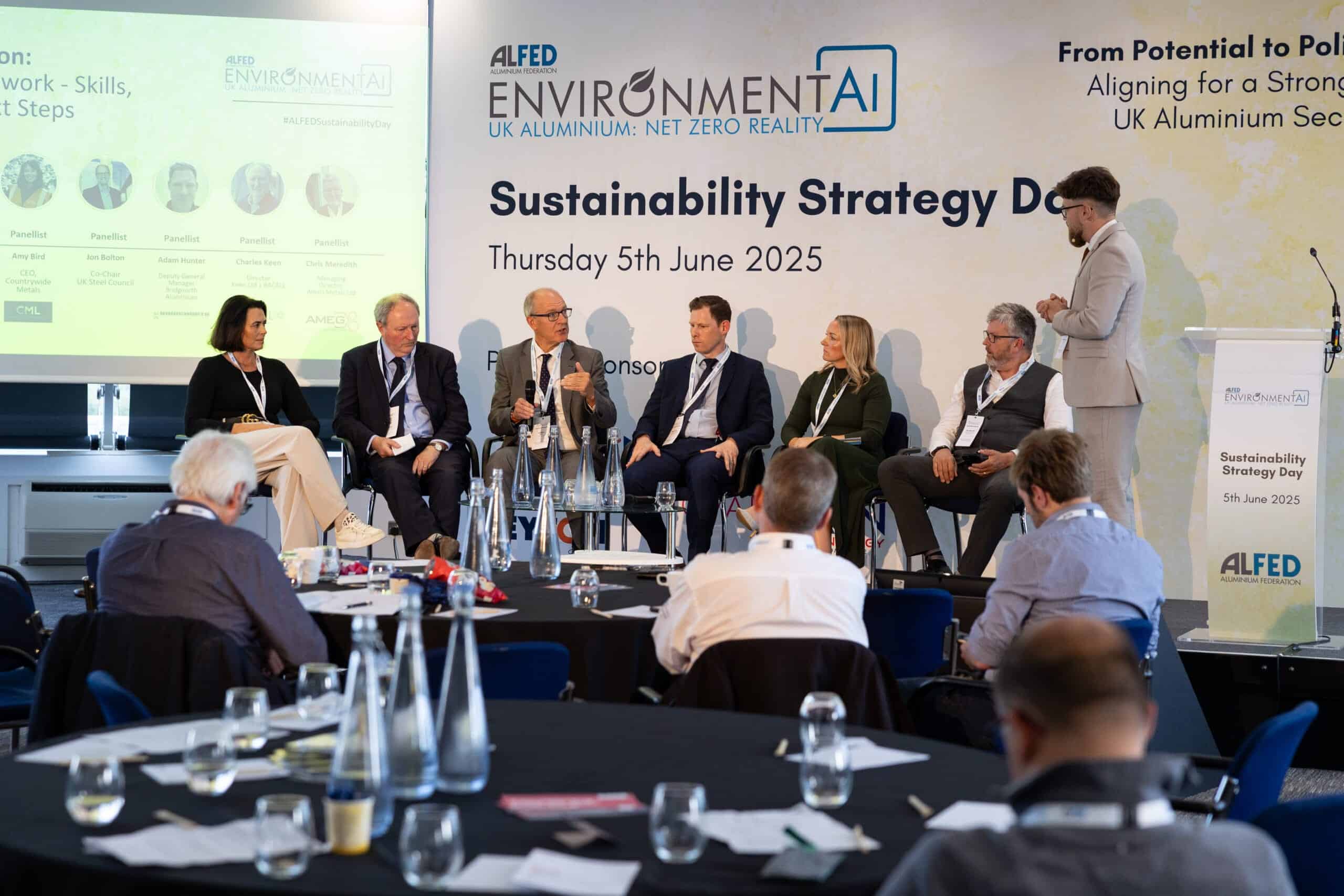
What we learned at the ALFED Sustainability Strategy Day
Why This Matters
- Reduces fragmentation by turning individual challenges into shared, actionable priorities.
- Provides every ALFED member with access to dashboards, benchmarks, skills tools, and policy packs.
- Amplifies aluminium’s strategic role in UK industrial strategy, net zero, and defence.
- Creates visibility and credibility with buyers, OEMs, and government, strengthening procurement opportunities and investment cases.
- Ensures SMEs as well as large companies have a voice in shaping the sector’s future.
The UK Aluminium Alliance matters because it:
As Nadine Bloxsome, ALFED CEO, says:
“The UK aluminium sector cannot afford to be overlooked. Building a UK Aluminium Alliance ensures our industry is part of the conversation – driving real change, unlocking investment, and setting out a clear vision for the future. It’s time we stepped forward with one voice, and this Alliance is how we begin.”

Next Steps for the UK Aluminium Alliance
On 23rd October 2025, ALFED will host the first UKAA Roadmapping Workshop at ALFED HQ, bringing together members, OEMs, and tiered suppliers from automotive, aerospace, defence, construction and packaging.
This session will:
- Map near-term and long-term product demand and standards implications.
- Identify processing bottlenecks and opportunities for better asset use.
- Define longer-term capability and skills pathways.
Post-workshop, ALFED will:
- Publish an aggregated workshop pack with demand snapshots, standards actions, refreshed capability maps, and HS 7602 grade visibility updates.
- Provide the “AS-IS” baseline: a validated, anonymised picture of current UK aluminium flows and capability (HS 7602 grades, processing assets, regional capacity and typical lead times), released as a member dashboard with a public-safe summary.
- Roll out the UK Aluminium Skills Pathway with the Aluminium Allies mentoring programme.
- Deliver quarterly policy packs to government, translating Alliance outputs into clear decisions and reforms.
All ALFED members automatically benefit from UKAA outputs. If your company is not yet part of ALFED but wants to shape the future of aluminium in the UK, influence policy, and gain access to collective tools and opportunities, join ALFED and become part of the UK Aluminium Alliance.
Get Involved
Whether you’re a recycler, extruder, processor, manufacturer, or supplier – the Alliance is open to you.
For more information or to express interest in joining the UK Aluminium Alliance, contact nbloxsome@alfed.org.uk